What Will It Take for India to Recycle Millions of Worn-Out EV Batteries?
Apr 28, 2025
**The EV Revolution Is Here. Is India Ready to Recycle Its Batteries?**
India is on the cusp of an electric mobility transformation. As government incentives, growing environmental awareness, and advancing technologies continue to accelerate EV adoption, there's a less visible but urgent question looming over the industry:
What happens to all these EV batteries when they reach end of life?
**1. The Clock Is Ticking on Battery Waste**
By 2030, India is expected to have over 10 million electric vehicles on the road. That's not just a number, it's a signal. It tells us that by the early 2030s, we'll be dealing with a substantial wave of used Lithium-ion (Li-ion) batteries, many of which currently lack a clear end-of-life roadmap.
Unlike traditional lead-acid batteries, which have a relatively mature and well-established recycling ecosystem, Li-ion batteries are far more complex. They contain valuable metals such as Cobalt, Nickel, Lithium and Manganese, intermixed with flammable electrolytes and sensitive electronic components. Improper disposal isn't just wasteful, it's dangerous.
**2. India's Recycling Ecosystem: Nascent but Growing**
At present, India's battery recycling infrastructure is still in its infancy. A handful of startups and material recovery firms have started addressing the gap, but large-scale sustainable recycling operations are still rare.
Companies like Attero and Lohum are pioneering domestic recovery operations, extracting critical materials and enabling partial reuse. However, these efforts must scale up dramatically to meet future demand. India cannot afford to replicate the mistakes of other fast-growing tech economies where battery waste has piled up faster than infrastructure could manage.
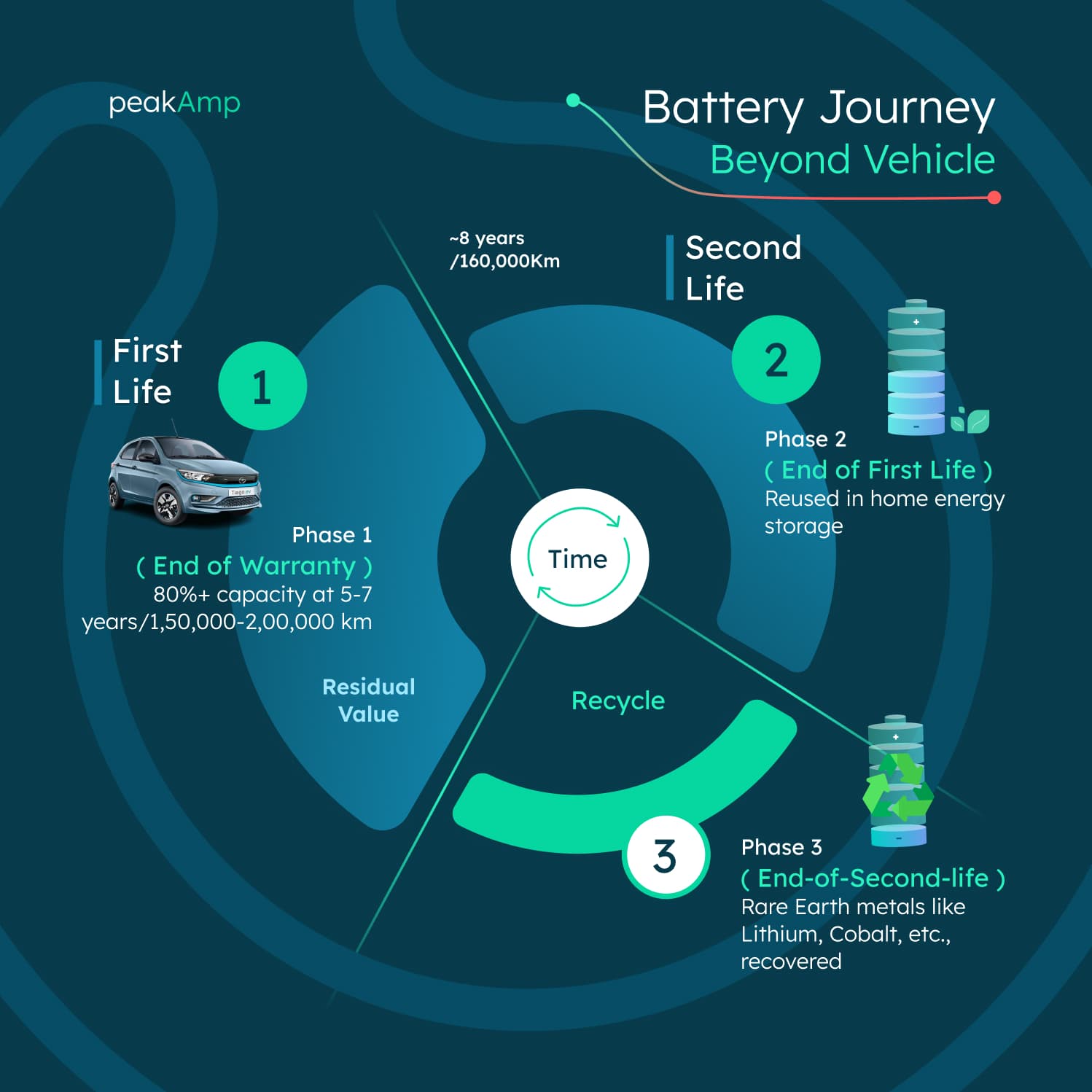
At peakAmp, we've seen firsthand the value of second-life applications. Recovered cells from EV batteries can power less demanding systems such as low power DC devices, decentralised stationary energy storage, solar and renewable integration or low-speed electric mobility, before they head into final recycling. But for that to happen, standardized collection systems, safe handling protocols and reverse logistics networks must be built today.
Recycling Li-ion batteries is a technically demanding task. But it also presents a massive opportunity for India to reduce import dependency, create jobs, and build a circular economy for critical materials.
**India needs:**
- Policy frameworks that incentivize battery take-back programmes and reward sustainable end-of-life (EOL) practices.
- Investment in R&D for safe, efficient and cost-effective recycling processes tailored to Indian conditions.
- Public-private partnerships to scale infrastructure in line with EV adoption rates.
- Battery passports or traceability systems to track usage, performance, and degradation, ensuring safe reuse and recycling.
The government's Battery Waste Management Rules (2022) are a step in the right direction. But execution will be key. Manufacturers, recyclers and policymakers must work together to close the loop, before it breaks.
India's EV dream won't be measured solely by how many vehicles we put on the road. It will be judged by how sustainably we handle what we leave behind.
The question is no longer whether EV battery recycling is important. The real question is: Are we moving fast enough?
Want to learn more?
Our experts are ready to discuss how PeakAmp can help your organization achieve its sustainability goals.
Schedule a Consultation